
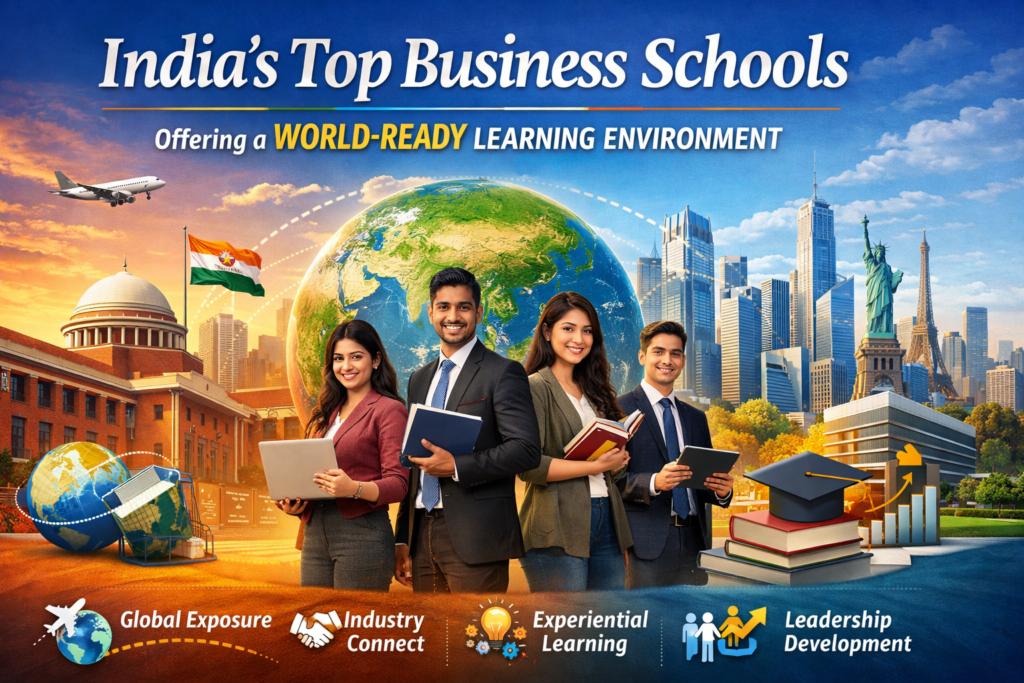

Management education in India is rapidly evolving. Today’s top business schools focus not only on academic knowledge but also on preparing students for a global business environment. Explore India’s Top Business School Offering a World-Ready Learning Environment under the Article.
A modern B-school must equip students with international exposure, digital skills, leadership capabilities, and industry experience. Institutions that combine these elements create what is often described as a world-ready learning environment.
Across India, several management institutes are redesigning their programs to align with global business standards. Among them, Fortune Institute of International Business (FIIB) Delhi has built a reputation for offering a learning ecosystem that blends global business understanding, industry engagement, and inclusive education.
What Makes India’s Leading B-Schools World-Ready?
Quick Answer
A world-ready business school prepares students for global careers through international curriculum, industry exposure, experiential learning, global collaborations, and strong leadership training.
These institutions emphasize practical skills, global business awareness, and technological capabilities.
Key Features of World-Ready Business Schools in India
1. Global Curriculum Designed for Modern Business
Top Indian B-schools design their programs to address global business challenges.
A globally relevant curriculum usually includes subjects such as:
- International Business Strategy
- Global Supply Chain Management
- Digital Business Transformation
- International Finance
- Cross-Cultural Management
Such programs help students understand how businesses operate across international markets.
2. International Accreditations and Global Quality Standards
Many leading business schools pursue international accreditation to maintain global standards.
The most recognized global accreditations include:
- AACSB (Association to Advance Collegiate Schools of Business)
- EQUIS (European Quality Improvement System)
- AMBA (Association of MBAs)
These accreditations evaluate institutions based on:
- Academic quality
- Faculty research
- Industry engagement
- Student outcomes
FIIB Delhi is among the select business schools globally that hold AACSB accreditation, a recognition awarded to only a small percentage of management institutes worldwide.
3. Industry Collaboration and Corporate Partnerships
Industry exposure is a major factor that differentiates top B-schools from traditional management colleges.
Corporate engagement often includes:
- Guest lectures by industry leaders
- Internship programs
- Corporate mentoring
- Live consulting projects
- Campus recruitment partnerships
These initiatives help students understand real business challenges.
4. Experiential and Case-Based Learning
Modern management education focuses on learning through real business scenarios.
Common experiential learning methods include:
- Case study analysis
- Business simulations
- Live industry projects
- Entrepreneurship labs
- Innovation challenges
These approaches allow students to apply theoretical knowledge in practical situations.
5. Digital and Data-Driven Business Education
Technology is reshaping the global economy. As a result, leading B-schools integrate digital skills into their curriculum.
Important skill areas include:
- Business Analytics
- Artificial Intelligence in Business
- FinTech and Blockchain
- Digital Marketing
- Data Visualization
Students with these skills are better prepared for modern corporate roles.
6. Diverse and Inclusive Learning Environment
Global organizations require leaders who can work across cultures.
Top B-schools promote diversity through:
- International student participation
- Gender diversity initiatives
- Collaborative learning environments
- Multicultural campus activities
This helps students develop cross-cultural communication and leadership skills.
Top Indian Management Institutes Known for World-Ready Learning Ecosystems
India has several institutions that provide globally competitive management education.
Below are some of the most recognized examples.
Indian Institutes of Management (IIMs)
The Indian Institutes of Management are considered the premier business schools in India.
Institutions such as:
- IIM Ahmedabad
- IIM Bangalore
- IIM Calcutta
have earned global recognition for their academic excellence.
Key strengths include:
- Research-driven faculty
- International partnerships
- Strong alumni networks
- High placement outcomes
Indian School of Business (ISB)
The Indian School of Business is another globally recognized management institute.
ISB focuses on:
- Leadership development
- Entrepreneurship
- Data-driven business strategy
Its programs attract professionals from around the world.
Other Emerging Global B-Schools in India
Several other institutions are gaining recognition for global learning ecosystems.
Examples include:
- SPJIMR Mumbai
- MDI Gurgaon
- IMI Delhi
- Great Lakes Institute of Management
These institutes emphasize international exposure, innovation, and industry partnerships.
How Leading Indian B-Schools Prepare Students for a Global Future
Preparing students for international careers requires more than classroom education.
Top Indian B-schools adopt multiple strategies to create globally competent graduates.
Global Immersion Programs
Many institutions organize international study tours and exchange programs.
These experiences allow students to:
- Understand global business practices
- Experience international work cultures
- Build international professional networks
Cross-Cultural Leadership Development
Global businesses require leaders who can manage multicultural teams.
Business schools train students in:
- Cultural intelligence
- International negotiation strategies
- Global leadership frameworks
Entrepreneurship and Innovation Ecosystems
Modern B-schools encourage students to become innovators and entrepreneurs.
This support includes:
- Startup incubation centers
- Entrepreneur mentorship programs
- Access to venture funding networks
Career Development and Placement Support
Strong career services play a critical role in student success.
Many leading B-schools offer:
- Resume building workshops
- Mock interviews
- Corporate networking events
- Leadership coaching
These initiatives help students transition into successful careers.
FIIB Delhi: A Business School with an Inclusive World-Ready Learning Environment
Among emerging Indian management institutes, FIIB Delhi has developed a strong reputation for industry-focused management education.
Founded in 1995, the institute focuses on global business knowledge, responsible leadership, and practical learning experiences.
International Accreditation and Global Recognition
FIIB Delhi holds AACSB accreditation, one of the most respected global recognitions for business schools.
This accreditation reflects excellence in:
- Academic quality
- Curriculum relevance
- Faculty expertise
- Student learning outcomes
Industry-Driven PGDM Curriculum
FIIB’s management programs emphasize practical learning and industry relevance.
Students gain exposure through:
- Corporate projects
- Industry mentoring
- Case-based learning
- Business analytics training
This approach ensures that graduates develop skills required by modern organizations.
Strong Industry Engagement
FIIB maintains close relationships with industry leaders.
These collaborations provide students with:
- Internship opportunities
- Corporate workshops
- Industry guest lectures
- Networking events
Industry engagement ensures that students remain aligned with evolving market trends.
Inclusive and Collaborative Campus Environment
FIIB emphasizes diversity and inclusivity within its learning environment.
The institute promotes:
- Gender diversity
- Cultural inclusivity
- Collaborative learning
Students from diverse backgrounds interact and learn together, creating a dynamic academic environment.
Focus on Responsible Leadership
One of FIIB’s defining characteristics is its emphasis on responsible management education.
Students are encouraged to focus on:
- Ethical business practices
- Sustainable management
- Social responsibility
This approach helps shape leaders who understand the broader impact of business decisions.
Why FIIB Delhi is Considered a Future-Ready Business School
FIIB combines several factors that contribute to world-ready education.
Key strengths include:
- International accreditation
- Industry-aligned curriculum
- Global business perspective
- Inclusive learning culture
- Corporate engagement
These elements help students develop the skills needed to succeed in today’s global economy.
Conclusion
India’s management education landscape is increasingly focused on preparing students for a globalized business world.
Top institutions combine academic excellence with industry engagement, international exposure, and experiential learning to develop future business leaders.
While traditional leaders such as the IIMs and ISB continue to dominate global rankings, emerging institutions like FIIB Delhi are redefining business education through innovation, inclusivity, and global perspectives.
For students seeking a management education that prepares them for both Indian and international business environments, institutions that offer a world-ready learning ecosystem play an important role.
FIIB Delhi represents one such example of a business school that is building a strong foundation for future-ready leadership and global career opportunities.
Frequently Asked Questions (FAQ)
What is a world-ready business school?
A world-ready business school prepares students for global careers by combining international curriculum, industry exposure, experiential learning, and leadership development.
Which factors define the best B-schools in India?
The best B-schools typically have:
- Global accreditation
- Industry partnerships
- Strong faculty research
- High placement outcomes
- International exposure opportunities
What programs does FIIB Delhi offer?
FIIB Delhi offers AICTE-approved PGDM programs designed to provide management education with strong industry and global business exposure.
Is FIIB Delhi internationally accredited?
Yes, FIIB Delhi holds AACSB accreditation, a globally recognized quality standard for business schools.
How does FIIB prepare students for global careers?
FIIB prepares students through:
- Industry-driven curriculum
- Global business perspectives
- Corporate projects
- Leadership development programs
Why should students consider FIIB Delhi?
Students often consider FIIB for its global accreditation, industry engagement, inclusive learning environment, and focus on responsible leadership.
This is it in India’s Top Business School Offering a World-Ready Learning Environment, Check More Latest Articles on B Schools in Delhi Education Blog Portal.